Farnsworth House 2015

Last week. Maybe next week too.
It has been 13 months since I last blogged about the Farnsworth House (Ludwig Mies van der Rohe, 1951). In that blog I detailed the various options that had been studied to try to conserve the house despite the increased flooding of the Fox River at its location near Plano, Illinois. Continue Reading
Mayor Emanuel fumbles first landmarks test

Okay, so a couple years ago a career gadfly and scold sued the City of Chicago claiming the Landmarks Ordinance was vague and arbitrary, the sort of legal challenge first-year law students learn about before they move on to the real stuff. But this is Chicago, and this is Illinois, and three judges at the Appellate level agreed with the charge, mostly based on the fact that the criteria in the ordinance were “vague” because they used words like “significant” and “values” and “importance” which of course caused me to opine and label the whole thing “Appellate Nuttiness” at the time.
The case is still out there and now we have Mayor Rahm Emanuel, who is already facing the question of whether we should have three vacant city blocks in a row just east of Michigan Avenue in Streeterville (the Prentice Women’s Hospital issue) and he also gets to appoint people to the Commission on Chicago Landmarks, who are by ordinance “professionals in the disciplines of history, architecture, historic architecture, planning, archaeology, real estate, historic preservation, or related fields, or shall be persons who have demonstrated special interest, knowledge, or experience in architecture, history, neighborhood preservation, or related disciplines.” Continue Reading
Prentice Women’s Hospital, Chicago

The next great new building in Chicago is Perkins and Will’s new hospital building for the Rush-Prebyterian St. Luke’s Hospital complex on the Near West Side. The new building features a multi-lobed design rising above a square base, looming over the Eisenhower Expressway and expressing with its insistent curving form a humanism central to the successful medical relationship. It is new and exciting. Continue Reading
Wrigley Building and other non-landmarks
In a week a new school year will start and this blog will celebrate its fifth birthday. It is August 2010, and in the old days August was a time when people were vacationing and out of the office and out of touch with the media so it used to be a good time to tear down buildings or approve plans that might not otherwise have public support. I don’t see that this summer in Chicago, but there are landmarks in the news.
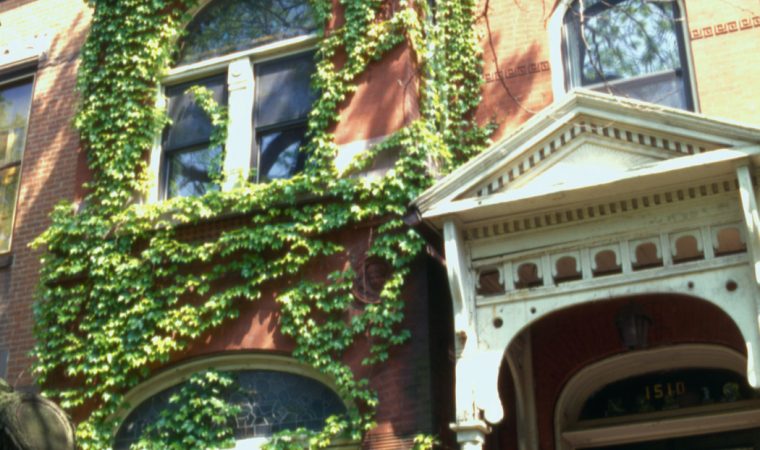
First, a moment to honor the passing of Phil Krone, political insider and dedicated preservationist, who led the first urban pioneers (according to the obituary Wednesday, he coined the term “urban pioneer”) to restore the 1500 block of West Jackson Boulevard, the sole west side historic district in the early days. This is one of the city’s smaller historic districts, but it is significant – a rare remnant of a thriving exclusive 19th century neighborhood. Krone didn’t stop there – I remember him telephoning me in 1989 with some idea about how to save some landmarks we were striving to preserve at Landmarks Illinois, and he telephoned me again last year with ideas about how to save the Gropius buildings at Michael Reese Hospital. In the late 90s it seemed he was at all the meetings of the Illinois Historic Sites Advisory Council, listing buildings on the National Register of Historic Places. He was a true friend of preservation and will be missed. Continue Reading
Bradley House, Inland Steel, Wrigley Field

The big news this week was an effort to preserve Frank Lloyd Wright’s Bradley House in Kankakee, one of the epochal early Wright Prairie Houses. Blair Kamin did a bangup job of covering the issue in the Tribune here. A local Wright in Kankakee group is trying to raise money to buy the house and make it a house museum and education center. The bottom line is the $1.9 million price and the more immediate concern of an additional $100,000 for the down payment beyond the $70,000 already raised. I can recall when the house was law offices and Kamin’s article notes that the owners for the last 5 years, the Halls, have been ideal, keeping it together and restoring it. With 100 art-glass windows, the house could be worth almost as much in pieces as it is put together. The real challenge is not simply the purchase price, but the ongoing operations, since house museums rarely generate more than a quarter of operating costs from admissions. The Bradley House either needs an angel to subsidize the purchase and an endowment, or it needs more angels like the Halls who will care for it as the treasure it is. Continue Reading
County Hospital

In Chicago today the news is the unanimous decision of the Cook County Board to rehabilitate the historic Cook County Hospital Building (1914, Paul C. Gephardt) as medical offices. Seven years ago the building was to be demolished after the new John Stroger Hospital replaced it, but Landmarks Illinois and Preservation Chicago and others were able to find enough County Board allies to prevent demolition, and the unanimous action yesterday illustrates the shift. The project also ably illustrates several intriguing aspects of rehabilitating historic buildings. Continue Reading