San Antonio Roundup July 2025

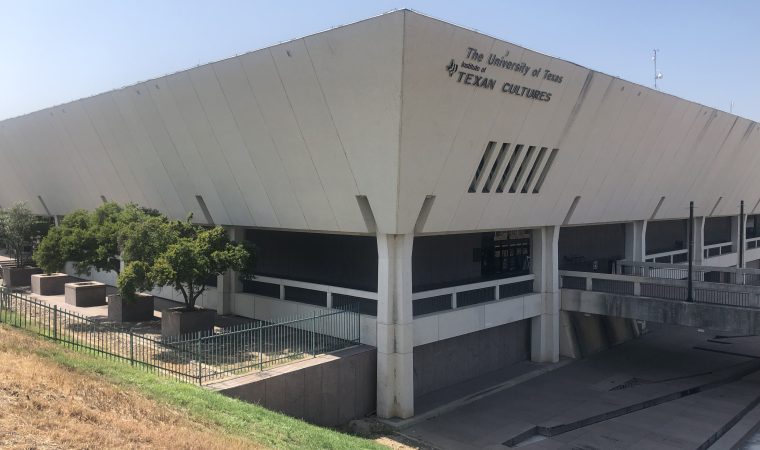
Two big losses this year – the Texas Pavilion (Institute of Texan Cultures building) has succumbed to demolition, seemingly accelerated by the Conservation Society’s failed attempt to get an injunction or even a hearing at either District Court or the 15th Court of Appeals. The unfortunate precedent being set is clear – if you want to demolish a property, make sure it is owned by an institution of higher learning, because they have a special carve-out in the State Antiquities code and may be willing to enter into a transaction for that privilege.

That loss was followed by the lame duck City Council approving the Digital Arts and Media Pilot Program, a digital billboard scheme that was opposed by 71% of those surveyed. Now we will have 10 Times-Square styled digital billboards attached to buildings and accompanied by artwork. All because one billboard company couldn’t play by the rules. Sigh. You can read my earlier blog here.

Speaking of public opposition, the City just wrapped up a couple weeks of workshops on the proposed Sports and Entertainment District previously known as Project Marvel. (Side note: one of the ways you know something doesn’t have great public support is that you have to keep renaming it. The Digital Arts and Media Pilot Program used to be Urban Entertainment Districts). The Express-News today had a feature on the “No Project Marvel” movement. I attended workshop sessions and it was actually pretty tame and useful. I should note that the Conservation Society has not taken a position on the Sports and Entertainment District. Some people did use the mapping workshop as a mechanism to vent.

It has been a difficult and chaotic time for most things, including historic preservation funding, as I blogged about in May here. The historic preservation tax credit did survive the OBBB, along with New Market tax credits, and the 2025 Historic Preservation Fund money was finally released. Solar credits were cut though, dampening one of Texas’ leading industries and giving China a big advantage.
On the plus side, a very cool 1906 Craftsman building in my Beacon Hill neighborhood that we deliver newsletters to is becoming a local landmark. I call it the house of Seven Gables.

Also on the plus side, the design and planning for the Civil Rights exhibit in the Woolworth Building that is part of the new Alamo Visitor Center and Museum is coming along very well. Can’t preview it but safe to say some great stakeholder input and some excellent design.


The biggest news has been the killer floods which claimed 13 lives in San Antonio and then more than 100 in Kerr County on the 4th of July when the Guadalupe River gained 20 feet in an hour and a half. The grim total may well exceed 200 including the flash floods in Travis and other counties. A combination of changing climate, Hill Country geology and limited notification systems came together in this catastrophe which has made the news worldwide and caused great grief and sorrow.
“A Little Learning…
is a dangerous thing” said Alexander Pope, and he recommended going whole hog (until Alps on Alps arise) or abstaining. Heritage conservation/Historic preservation is a specialized field, and like many specialized fields, the wider world has misapprehensions or misunderstandings about it. We can try to impart a little learning. There are pitfalls though, because misapprehension often rings truer than fact.
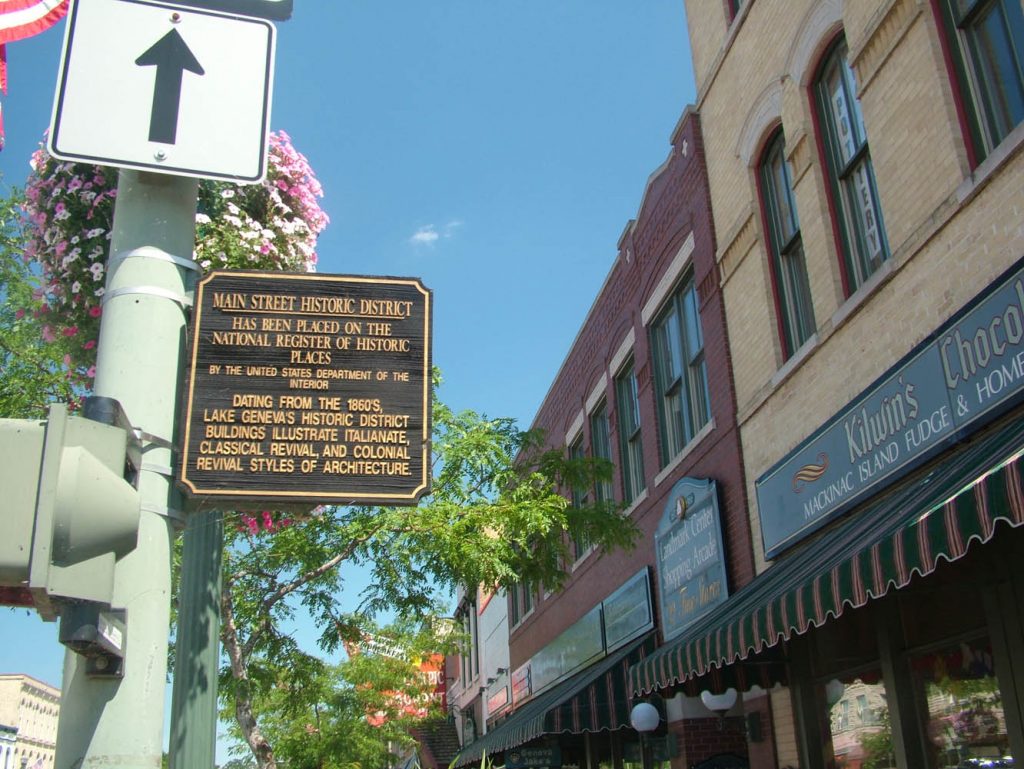
A case in point is the National Register of Historic Places. Its name is often misapprehended as “The National Registry” just because that sounds, well, classier. When a building, site, district or structure is listed on the National Register of Historic Places that means it can’t be torn down, right?
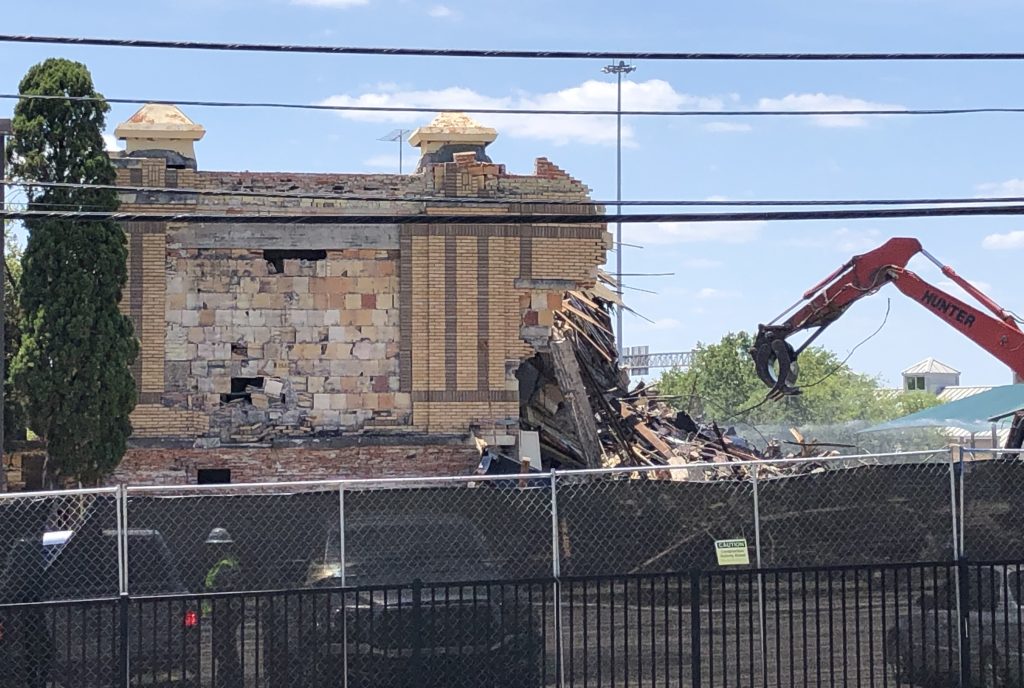
Wrong. Also, Wrong. And Wrong again. The list has been around since 1966 and provides no protection against demolition. It DOES provide a review process that MIGHT make demolition less likely, but that is only if it is literally a federal case. It is kept by the Secretary of the Interior, who will have no idea if anyone is going to tear it down unless a federal agency tells the Secretary they are going to. And they can still tear it down, but only after going through the process.

310 W Polk, Chicago, demolished 1991 by the Postal Service because they knew that the National Register doesn’t prevent demolition.
Now, you can explain that time and time again, but it won’t stick, because the misapprehension is so much more plausible. That’s what it SHOULD mean, right? What really amazes me is that people in high positions dealing with real estate and so forth not only don’t get this, but they suspect there is some weird detail of the National Register that is going to somehow – magically – thwart them. Because it is a specialized field. Fear is always based on lack of knowledge.
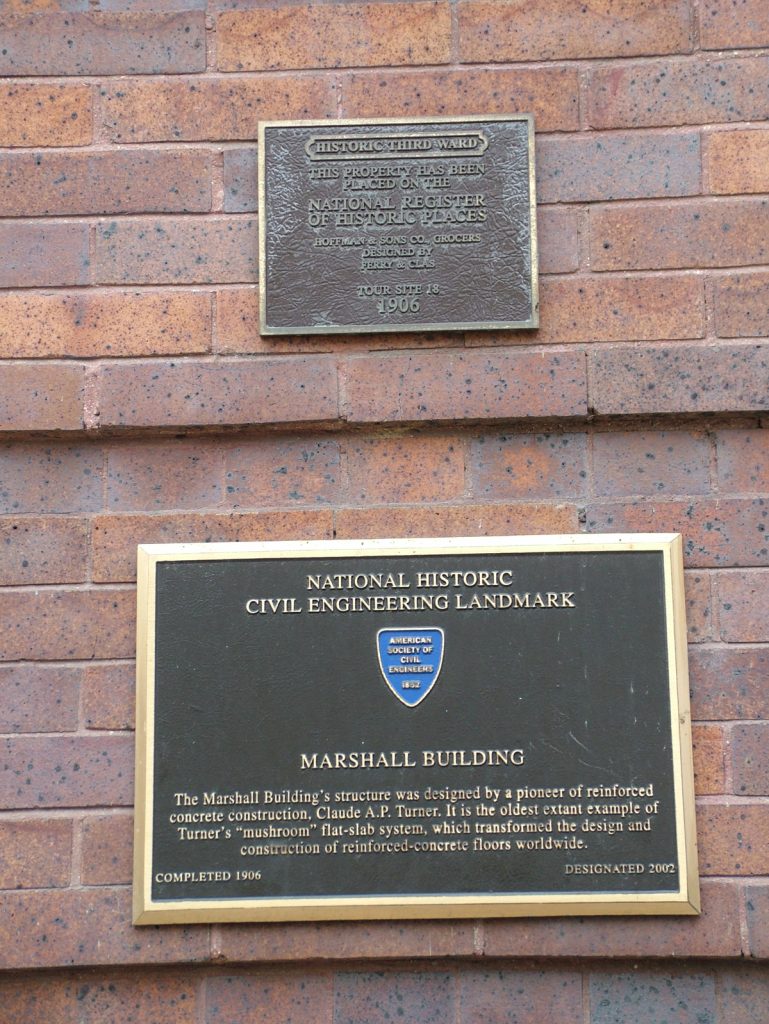
Even though the National Register can’t prevent anyone from tearing down anything (there I said it again, but you still don’t believe it, right?) it can provide – since 1976 – preservation tax incentives that can be used to restore the resource. Part of the reason we have so many buildings on the National Register is that real estate developers put them there in order to get a 20% investment tax credit. $2 million off your taxes for a $10 million rehab. Not bad.

But wait, there’s more! In Texas, you can get an additional 25% tax credit ON TOP of the federal one, so your $10 million rehab only costs you $5.5 million. Or, in the case of the St. Anthony above, more than $24 million in tax credits. So who wouldn’t want the National Register – it can finance your rehab or, you can ignore it and tear it down! No downside, right?

Another historic tax credit project, right across the street.
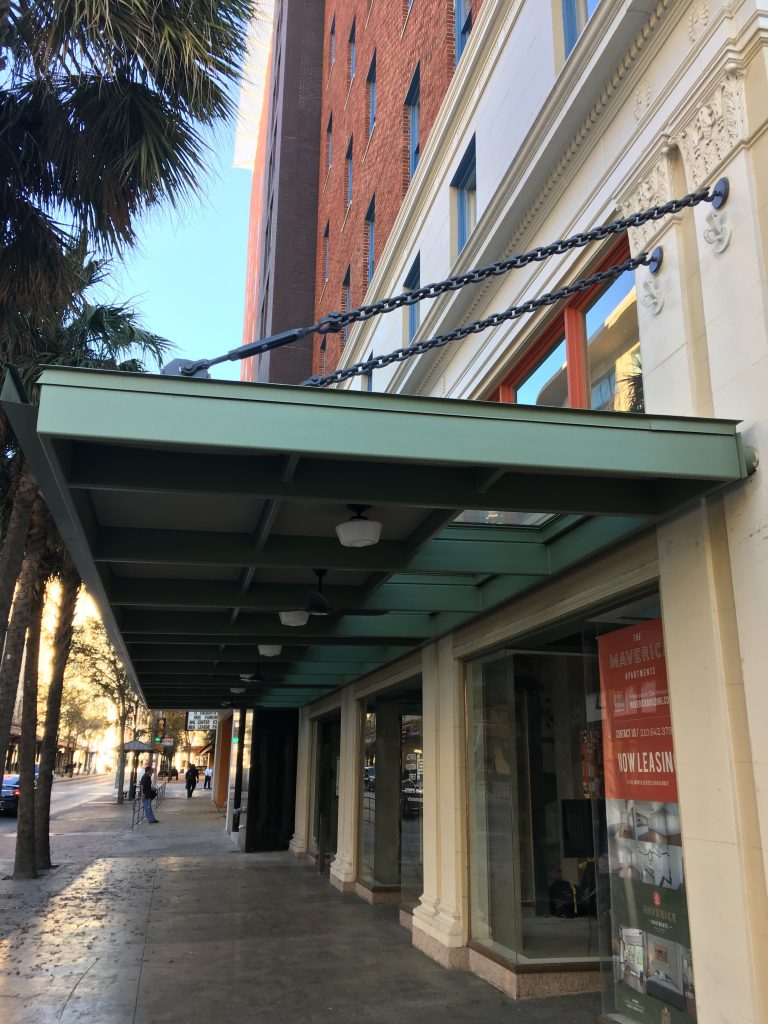
And another, across the street again. Not rocket science.
No downside unless you are a victim of misapprehension, or magical thinking. Case in point: the Conservation Society of San Antonio has nominated of the Texas Pavilion/Institute of Texan Cultures building (1968, Caudill, Rowlett & Scott) to the National Register of Historic Places. Its owner, the University of Texas at San Antonio, is going to oppose the nomination because they want to “monetize the site.”

Okay. Site. Money. Weren’t we just talking about a tax incentives worth 45% of rehab cost? That would be an attraction to someone buying it. BUT, they assume it will be torn down so Spurs Stadium IV (A New Hope) can be built on a smaller site than the Spurs II and III. So? You are the UT System, you can do what you want. In fact, the State and the UT system don’t even have to ask the city for a demolition permit like the rest of us.

As they proved with the Sutton Building in 2019.
So why would you oppose National Register listing if it adds potential incentives and doesn’t prevent demolition? How could you be so powerful and not understand your power? You don’t quite believe that truth because it doesn’t feel true – this is the National Registry (sic) after all!

Civilization and the current moment are saturated with people following courses of action that contradict their fiduciary responsibilities because they have a better storyline. This National Register thing has got to be a big green dragon – it can’t be as innocuous as they say, right?

Oh look, another historic tax credit project!
A good storyline beats the bottom line any day.
A little learning is a dangerous thing.
JANUARY UPDATE: We got a unanimous vote from the State Review Board so now it is up to the State Historic Preservation Office to forward the nomination to the Keeper of the National Register (or not). We had 9 speakers in favor at the hearing in Galveston and they also received 47 letters of support and many more online expressions of support. UTSA provided the sole opposition to the listing.
FEBRUARY UPDATE: University of Texas Board of Regents voted in secret to either lease or sell the ITC to the City for a new Spurs arena. No one is talking, though.
The Spurs probably have enough tax liability that they could use the historic preservation tax credits themselves, avoiding a syndication!
Demolition Daze


It’s July in San Antonio, which means it is probably hot and it is definitely time to demolish landmark buildings. In addition to the unexpected demolition of the G.J. Sutton Building which began last week without an alibi, this week we are also witnessing the needless removal of two homes on Evergreen near Tobin Hill that are going to be replaced by nine units. (Nine? You have two buildings PLUS a vacant lot and you can’t manage nine units by rehabbing? What development school did you go to?)

To add a heaping schlag of cruelty to this demolition sachertorte, they have little kids cheering the demolition of the 1915 Beacon Hill School. Sad. The School District promised to rehab the building three decades ago, let it rot that whole time, and then manipulated schoolchildren and their parents into calling for its demolition by putting up an unnecessary fence and pretending the building was a hazard to the nearby playground.

In another era, that would be called lying. Anyway, there were the kids in cute little hardhats, egging on the claws and dumptrucks and firehoses.


Who is responsible? The Sutton Building was a State decision that excluded the City. Evergreen and Beacon Hill were City Council decisions, and Almaguer was a Historic and Design Review decision. Meanwhile, check out this heat map showing demolitions near the Tobin Hill and Monte Vista historic districts.

Image courtesy City of San Antonio Office of Historic Preservation.
So, come to San Antonio in the summer! Where else can you get so many different and delightful demolitions going on at the same time? The sun might feel hot but we got lots of fire hoses running round the clock!
Frank Lloyd Wright Demolished

Last summer I was visiting my daughter in Kalispell, Montana, a lovely historic town. One day we toured nearby Whitefish, which has a small history museum but was quite the contrast, as I mentioned in a blog HERE. The one highlight was our discovery of a late Frank Lloyd Wright building, even labeled as such – completed as a medical office in 1961.

I am on the Board of the Frank Lloyd Wright Building Conservancy and at the time I remembered the controversy and concern for the building. Modest, it still echoed the Marin County complex in its rolling sculpted eave and horizontal emphasis.


But this week it looks like this

Why? The pat answer is greed, but the real answer is hidden behind a seeming expression of greed: $1.7 million. The blatantly unreasonable request almost sounds like “$1.7 million or I kill the building!” And he followed through, which may have been the intention all along. The piles of rubble remind me of the 1972 piles of the old Chicago Stock Exchange, which was similarly flipped up until it had a price it could not sustain, because real estate is the only asset class whose value is fully externalized.

It is usually a con. Those silly preservationists think it is valuable, so I will ask them for too much money and then blame them when I demolish it. Which is exactly, in every aspect, how a kidnapping for ransom works.


This was the trade Chicago made in 1972 after the Adler & Sullivan Chicago Stock Exchange was flipped by promoters to an unsustainable value. To be replaced by a physical absence, a building that you can’t even look at for more than a second if you try.
So, that is the greed angle and the ransom angle, but what about The Vacant Lot Myth: that a cleared site is worth more for an owner? I covered this a couple years back HERE. It is like The Beige – what realtors tell you to paint your walls to appeal to the widest possible audience. Not the best audience, not the best price, but the largest potential market. Which leads to absences.


Here is your tradeoff!
Sadly, the absence in Whitefish builds on a local legacy of absence. There is a plaque where they tore down their oldest building about five years ago. Tourists may still come through on their way to Glacier Park but they will have less reason to linger, less to see, and less to remember.
Plainfield: Historic?

Another downtown bites the dust – or should we say drinks the Kool-Aid? The latter phrase has been overly misused the last decade or two but it is quite appropriate. Historic downtown Plainfield – a lovely Will County town west of Lockport, has voted down historic landmark status, despite a 21-20 majority of downtown property owners being in favor of it. This was reported in the Chicago Tribune today.
Despite the slim majority of owners in favor, Village trustees voted 4-2 against the district, essentially caving to a minority. Negative motivations – like fear – tend to trump the positive motivations, like the economic security provided by knowing what kind of downtown you are going to have in the future. Another negative motivation: fear of the frightening property regulators, who have somehow not interfered with two renovations of this historic property owned by Pat Andreasen, listed on the state, national and local registers.