Preservation by Design® Four Points

Global Heritage Fund is distinguished by its approach to saving heritage sites, and that approach, called Preservation By Design®, has four points: Conservation, Planning, Partnerships and Community Development. The latter point is what distinguishes us from traditional preservation advocacy groups, so we will get to that.
In a few weeks, I will be moderating a panel discussion with Global Heritage Fund project leaders at the Legion of Honor in San Francisco. The panel will focus on these four points so I thought I might preview the discussion here. Continue Reading
Destruction of Heritage

When cultural heritage is targeted for destruction, everyone asks us what can be done? Can’t we swoop in and save these priceless millennia-old artifacts? I get asked this question a lot. Continue Reading
Investing In the Future

The investments that pay off over time are ones that are made with a complete understanding of the context. What or who are you investing in? What is the potential for growth? What are the obstacles, and conversely, the opportunities? The act of investing is future-oriented, so there is always risk, but successful investors learn to minimize risk.
Philanthropists often look on their donations as investments, especially here in Silicon Valley. This makes it incumbent on organizations like Global Heritage Fund to measure those investments for our donors. We need your help, yes, but we know we need to prove to you how much you can help. Continue Reading
Beyond the Bounds of Conservation

I hope you are a member of the organization I run, the Global Heritage Fund.
Our goal is to help save world heritage sites in impoverished regions by activating them as assets for the local community. Our methodology combines Planning, Conservation Science, Partnerships and Community Development, which we term Preservation By Design®. Our goal in our second decade is to make our Community Development more robust and replicable. Continue Reading
Planning for the Future; not Scrambling for the Past

I was re-reading one of my blogs from nine years ago (430 posts now – I guess I am about consistency and endurance whether I like it or not) and was struck (again) by my (consistent) non-ideological approach to heritage conservation. That blog “Heresy and Apostasy” basically took to task the concept that preservation had some kind of ideological purity and that those who didn’t try to save absolutely everything all the time were not “true” preservationists.
I recalled my youth in the field, when I did come close to that position, but it was never one I was completely comfortable with. First, ideologies sit outside of history and thus fail all tests of time. Second and more to the point, I began my career working on a heritage area – the first in the U.S. – and the goals there were historic preservation, natural area preservation, recreation, and economic development. Preservation was part of planning for the future. Preservation was a wise economic decision, especially in a post-industrial economy. Continue Reading
Sustainable Development

Sustainability has been a popular buzz word for quite a while now, and the basic meaning is pretty clear: do things in such a manner that you can continue to do them.
When it comes to natural resources, it means using them in a way that does not deny the next generation the opportunity to use them. When it comes to economics, it means a system of effort and reward that can bring prosperity to the next generation, not just the current one. When it comes to society, it means that social structures, human rights and livable communities are likewise structured in a way that they can be passed on to the next generation. You get the basic idea: Do things in a way that allows you to keep doing them. Continue Reading
Stepping Into World Heritage and Why

It has been six years since I wrote about stepwells, those amazing structures found throughout the Indian subcontinent. Communal water sources, stepwells range from simple community structures to elaborate complexes replete with stunning architectural detail. When I wrote six years ago I described the Adalaj stepwell in Ahmedabad, but I only included a single image, so I am remedying that here. Continue Reading
Leading with Expertise

The Sun Temple in Weishan, last week.
In approaching the second decade of the Global Heritage Fund, I have spoken of “Leading With Expertise”. This means going into a heritage sites in a developing region not with a massive restoration plan but with the best minds in modern conservation. This allows you to determine the best plan from both a conservation and community point of view, by determining precisely what the problems are and how best to approach them. It means resources are used more wisely, and by bringing in the best conservation experts we can leverage more partners, spreading the cost burden across many international, national and local entitites. Continue Reading
Yangon Heritage
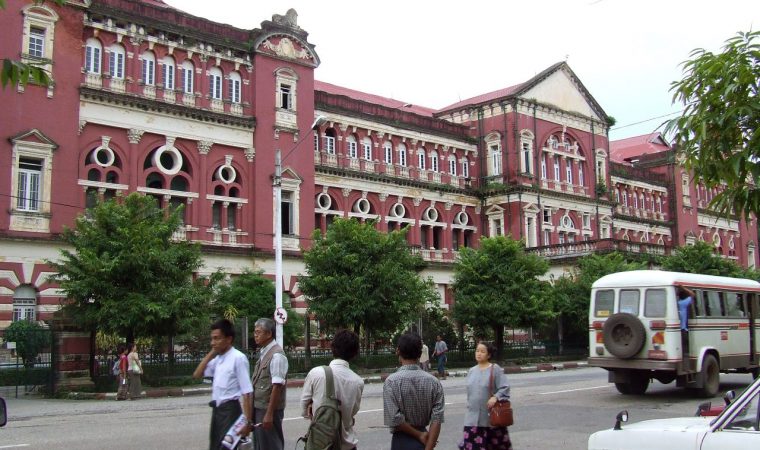
Rangoon. The Garden City of the Orient. It really was, and thanks to a half-century of neglect, it still is. Sort of like Havana, Rangoon gives you that sense of stepping back in time, before the glass skyscraper shopping centers, before Rayon and ubiquitous telephony. I rarely wax nostalgic but when I walked the streets of Rangoon in May of 1986, I fell in love with the colonial architecture.
You could feel the sense of time there. I have never been to Havana, but I have experienced the sense of time frozen in architecture in a few other places – Budapest a decade ago, Georgetown (Malaysia, not D.C.) in the 80s, even Leeds back in ’82. It is an architecture that begs for preservation but not restoration. It is messy but it is literally dripping with history; with significance.
Cultural Landscapes: The Confluence of Conservations

we could all use some of this
I have blogged previously about the differences between natural area conservation and heritage conservation, especially in terms of use-value, as I wrote about last year in this blog. The basic point was that natural area conservation is largely about preserving non-use value – a liability (or at least an externality), while heritage conservation is about preserving use-value – an asset.
That blog also delved into the 41-year history of World Heritage, which includes both cultural, natural and “mixed” sites. I detailed how we had shifted in heritage conservation from iconic and monumental singular sites to broader cultural landscapes. In recent discussions with conservation foundations, I am sensing a new confluence of heritage conservation and natural conservation as both approaches are moving into the arena of cultural landscapes. Continue Reading