AI Slop

The phrase “AI Slop” is already commonplace, and it inspires me to invent more neologisms like “Cry me a data center” or “Grok willing and the creek don’t pop-up”. I have written all 670 blogs over the last two decades without AI, or have I? I am a late-adopter with Post Technology Stress Disorder and you can see that in my blogs from the aughty-aughts. Heck, you can see it from a couple of months ago when I ranted about how real retail service companies cannot ever, ever change an old email or recognize a different phone number, no matter who is dead. And they are willing to give up months of revenue just to carry that rotting corpse further.

So what do I think of AI? My first reaction to AI writing was that it was like a 14-year-old who has been asked to turn in a three-page essay but only has one page of material. Repetitive. You see it in tons of social media posts which look like proper long-form discussions but hammer the emotional hinge of the story like six times in 400 words. That is the written version of the AI image that has the wrong number of fingers or arms. Of course, both of those examples are a year old so I suppose by now AI is like 15 and knows how to draw hands better.

This is a real life photo from 12 years ago no AI.
I have attended one workshop and one training in AI in the last 24 hours so here is what I learned, mostly from Huy Pham and Paul Kim, whom I first saw present on this issue almost a year ago in Arkansas.

AI is a marketing term for the latest iterations of pattern recognition technology. Basically it looks at large amounts of data and identifies patterns and recurring themes. So, like you learned in computer science 40 years ago – GIGO. Garbage in, garbage out. Huy and Paul work for APIAHiP (Asian and Pacific Islander Americans in Historic Preservation) and if they ask AI about Asian sites in the National Register of Historic Places and if AI looks at all 100,000 nominations and sees less than 1% it will tell you basically NO. There aren’t any. Not significant. Not important.

Since AI is basically pattern recognition, everything it produces will tend toward the mean, the median, the average and ordinary. It is not a place to look for exceptionalism or new ideas. Culturally, it has a flattening effect. What is new about it in the last few years – as opposed to the pattern recognition software of 20 and 30 years ago – is the Large Language Model. Basically you give it tonnes more examples. So it gets even meaner. It cannot provide conclusions, only predictions. It reflects what is common, not what is true. Garbage in, garbage out.

I guess I’m not a big fan
If you want the National Register of Historic Places to identify underrepresented stories, you need to do it yourself, because it requires not lots and lots of old data, but a new approach. You need to reconceptualize the process, which is not something in AI’s wheelhouse. Garbage in, garbage out.

“Hallucinations,” however, are in AI’s wheelhouse. They will confidently answer a nonsense question like “Who won the Nobel Prize in Economics in 1956?” and even provide fake citations from nonexistent journals, as we have seen recently. It seems the AI doesn’t know how to say “I don’t know” which is a prerequisite of real intelligence. It eagerly answers queries because – like the 14 year old – it can’t not. Even if it is hallucinating.

If you get the “Nobel Prize in Economics,” you will get it here, in Stockholm, but it will actually say Sveriges Riksbank Prize in Economic Sciences in Memory of Alfred Nobel, and it only began in 1969. Four of the five original Nobel prizes are also delivered in Stockholm under the terms of Alfred Nobel’s 1895 will, with the Peace Prize awarded in Oslo.
Presents predictions as conclusions. Repeats what is common rather than what is true. Hallucinates.
No wonder the predator class and the oligarchy are so enamored of it.
More microdosing and unlocked tranches than Sand Hill Road.

So, does AI work with historic preservation? I have always said that the beauty of historic preservation is that it treats every resource as an individual, with individual characteristics and individual significance that cannot be commodified. Zoning treats properties as a category, like grain being graded and loaded into a silo. It becomes a commodity sans terroir. Pattern recognition technology might be suited for zoning or other commodifying tasks, but telling the story of a place is specific and nonfungible.

Terroir.
So, to answer the question: AI can help if you need to find out how many 1926-29 Tudor Revival houses in the Monte Vista district have casement windows or how many National Historic Landmarks are shaped like elephants.
But if you are nominating a site with a story that has not been heard before – AI doesn’t know. Because it hasn’t been told. And it doesn’t know what it doesn’t know.

Why doesn’t someone get AI to do the dishes or wash the floor? Something useful, you know?
106 under attack

I have regularly taught on online one-hour course for public officials on how to navigate Section 106 of the National Historic Preservation Act of 1966. Section 106 is a consultation process that reviews federal undertakings for their effect on historic resources. This makes it a regulation, so knuckle-dragging mouth-breathers with no knack for capitalism think of it as an obstacle. Skilled practitioners recognize it as a way to find solutions that satisfy constituents and guarantee return.

There is no law that prevents demolition of landmarks. Full stop. There are only laws that make it more difficult. But not impossible. In my class I share the story of the USPS in 1991 which decided to tear down a Daniel Burnham building. They knew how Section 106 worked, and that a federal agency can always out-wait the process and tear down the building. So they did.

This is when I was out standing in my field.
The virtue of Section 106 is that it may take time, but it saves lawsuits and conflicts that come afterwards. This week, the Advisory Council on Historic Preservation is proposing eliminating this consensus-building process, presumably at the behest of the aforesaid Neanderthal-adjacent. The National Trust for Historic Preservation has publically opposed the move, as has the National Preservation Partners Network. Here is our statement.
Position Statement: Opposition to Proposed Changes to Section 106 of the National Historic Preservation Act
Issued: July 23, 2026
Who We Are
The National Preservation Partners Network (NPPN) is a coalition of statewide and local preservation organizations and preservation professionals working alongside State Historic Preservation Offices, Certified Local Governments, and Tribal partners to protect historic and cultural places in communities across the country. Our members work directly with the Section 106 process on a daily basis — advising project sponsors, sitting at the consultation table, and helping communities and federal agencies reach outcomes that work for everyone. We offer this statement as practitioners with on-the-ground experience with the process.
Summary
The existing Section 106 process reduces conflict, identifies problems early, creates predictable outcomes, and avoids costly litigation. It is a process that works — not despite its consultation requirements, but because of them. The National Preservation Partners Network (NPPN) therefore opposes the draft rewrite of 36 C.F.R. Part 800 — the regulations implementing Section 106 of the National Historic Preservation Act (NHPA) — that was circulated by the Vice Chairman of the Advisory Council on Historic Preservation (ACHP) on July 17, 2026, for an expedited Council vote by July 24, 2026. NPPN urges the ACHP to withdraw the draft, restore the deliberative process it previously committed to, and preserve the collaborative consultation framework that has worked for sixty years.
Statement of Position
NPPN believes the proposed rule, both in the manner of its introduction and in its substance, is an unwarranted departure from the collaborative, multi-party consultation model that Congress established when it enacted the NHPA. NPPN calls on the ACHP to:
- Withdraw the current draft and restore the previously adopted 30/60-day process for developing and reviewing any revisions to Part 800.
- Reject an unassembled, one-week vote on a rule of this magnitude, and instead ensure Council deliberation occurs in a transparent, recorded public forum.
- Preserve the core consultative structure of Section 106 rather than replacing it with a model of unilateral agency control.
- Engage Tribal Nations through genuine government-to-government consultation on any changes affecting places of religious and cultural significance.
- Engage with the broader preservation community and the public in order to improve the Section 106 process without endangering or destroying historic places.
Background
For six decades, Section 106 has required federal agencies to identify historic properties, consult with State Historic Preservation Officers (SHPOs), Tribal Historic Preservation Officers (THPOs), Tribal Nations, local governments, and other interested parties, and consider alternatives before undertakings that affect historic properties move forward. It has never functioned as a veto over federal projects; rather, it has provided a structured process for balancing infrastructure, energy, housing, broadband, and disaster-recovery needs against the preservation of the nation’s irreplaceable historic and cultural resources.
Earlier this year, the ACHP adopted a resolution directing its staff to develop a public timeline for revising Part 800 within 30 days and to give Council members 60 days to submit comments before any regulatory action proceeded. That process was never completed. Instead, on the afternoon of Friday, July 17, 2026, the Vice Chairman distributed a nearly complete rewrite of the regulations and asked Council members to cast an unassembled, email-based vote within one week — abandoning the process the Council itself had adopted. The Council set a deadline of Friday, July 24, 2026, for that vote; the National Trust for Historic Preservation, a Council member, has already voted no. If approved, the draft would move to the Office of Information and Regulatory Affairs (OIRA) for review before publication in the Federal Register, triggering a 30-day public comment period.
Why Section 106 Benefits Everyone — Not Just Preservationists
Section 106 is not an obstacle that pits preservation against progress. In practice, it does the opposite. Section 106 works because it creates better projects: earlier identification of issues, fewer late-stage surprises, negotiated solutions, greater public confidence in federal decision-making, lower litigation risk, and greater certainty for project sponsors. Federal agencies, applicants, local governments, Tribal Nations, and the public all rely on the same process to get to “yes” on projects that serve infrastructure, energy, housing, and disaster-recovery needs. Weakening that process does not make federal projects move faster or cost less — it removes the mechanism that prevents costly conflicts and litigation from happening.
Key Concerns with the Proposed Rule
A shift from consultation to unilateral agency control. The draft replaces the collaborative consultation process with a single Section 106 report prepared by the federal agency, which would then be circulated for comment. SHPOs, THPOs, Tribes, local governments, and other consulting parties would react to a completed agency analysis rather than helping shape it — removing a substantive planning process. Agencies would decide unilaterally whether competing priorities, such as budget and schedule, outweigh historic preservation concerns.
Narrowed participation. Local governments and Certified Local Governments would no longer be entitled to consult, and preservation organizations and members of the public would lose recognized status. Public involvement becomes discretionary, with agencies deciding whether public input is worth the time and cost. Collaborative, negotiated solutions are lost.
Broad new exclusions from review. The proposal would exempt whole categories of projects — including state- or locally administered federal programs, actions involving minimal federal funding or control, and projects carried out under delegated authority. It would align many NEPA exclusions with Section 106, removing review of projects that currently receive it.
A narrowed definition of “effect.” The draft limits adverse effects to those that are foreseeable, closely tied to the undertaking, and involve material physical alteration. This curtails consideration of setting, visual impacts, and other indirect effects, and raising serious questions about how places of Tribal religious and cultural significance would be protected.
A narrowed definition of “historic property.” The proposal excludes certain cultural landscapes — mountains, valleys, and ethnographic landscapes — from protection. Combined with the loss of Traditional Cultural Landscape protections and the elimination of “avoidance, minimization, and mitigation” as an operating standard, these changes will reduce protection for Tribal sacred sites and Traditional Cultural Properties and disregard practical, positive alternatives that preservation review makes possible.
Mitigation becomes optional. The current process encourages negotiated Memoranda of Agreement among consulting parties. The proposed rule makes Memoranda of Agreement optional and allows agencies to make unilateral decisions without the agreement of consulting parties, likely leading to conflict.
Legal vulnerability and more delay, not less. The proposed regulations contradict both the National Historic Preservation Act and ACHP’s own rules and procedures. The internally inconsistent draft contains many errors, inviting regulatory confusion. Stripped of the well-established consultation process that has long produced negotiated, durable outcomes, agencies and applicants should expect more legal challenges and delays, not less — undermining the efficiency the proposal claims.
The draft is a complete rewrite that places decision-making authority in the very agency proposing the undertaking. It discards the independent expertise SHPOs, THPOs, Tribal Nations, local governments, and the public bring to federal decisions. Under the narrowed definition of “historic property,” federal agencies would no longer be required to take into account adverse effects to significant cultural landscapes like the Grand Canyon.
Call to Action
NPPN encourages its members and the broader preservation community to:
- Track the rulemaking closely and prepare to submit substantive comments once the rule is published in the Federal Register.
- Contact their Members of Congress to express concern about the proposed rule and the process by which it was introduced.
- Contact State Historic Preservation Officers, Tribal Historic Preservation Officers, and state and local elected officials to coordinate a unified response.
- Submit written comments during the forthcoming public comment period via regulations.gov once the docket number is available.
Conclusion
Section 106 has succeeded for nearly sixty years not despite its consultation requirements, but because of them. NPPN urges the ACHP to reject an accelerated, closed-door process for rewriting regulations and to engage the full preservation community — Tribes, SHPOs, local governments, preservation organizations, and the public — to uphold, rather than dismantle, Congress’s intent in enacting the National Historic Preservation Act.
NPPN’s opposition to this draft is not opposition to reform. NPPN stands ready to participate in a collaborative review of Part 800 that improves efficiency, provides greater clarity, reduces delay, maintains consultation, honors Tribal sovereignty, preserves public participation, and fulfills Congressional intent. We welcome the opportunity to work with the ACHP to that end.
Sources: Cultural Heritage Partners, “War Room for Threats to Section 106” (July 2026); National Conference of State Historic Preservation Officers, “The End of Section 106 as We Know It?” (July 20, 2026); Arizona Preservation Foundation, “ACHP Proposes New Federal Regulations that Devastate Protections for Historic Properties” (July 2026); National Alliance of Preservation Commissions, member advisory on proposed Section 106 regulatory changes (July 2026); National Trust for Historic Preservation, “Section 106 Is Under Threat: What You Need To Know” (July 2026).
Section 106 of the National Historic Preservation Act

Last week the Advisory Council on Historic Preservation put out a call for review of the Section 106 process. What is Section 106? Well, it is basically the federal review process for properties listed on (or eligible for) the National Register of Historic Places. I have taught this process to public officials for decades, and I have been party to the process in many cases, including several projects here in San Antonio.

Foundations of 1875 St. James AME Church as uncovered in 2020. Below is the result of the Section 106 process, completed 2022.

In a time characterized by assaults on civil institutions small and large, a “review” of this process, which has existed in some form for nearly 60 years, is cause for concern. Section 106 is a type of regulation, and regulations are often categorically opposed by self-styled populist politicians and struggling subpar businesspersons. The nuanced reality is that any consultative process will tend to improve outcomes.

With the notable exception of the Milton Historical Society, a Section 106 review that was a perfect storm of bad outcomes. I was hired by the National Trust to figure out what went wrong here 20 years ago. Architect, client, and agency were all at fault. In that order.
Almost a year ago, the Executive began trying to get around regulations like Section 106 through imaginary energy crises, military readiness, and other performative red herrings. Heck, they even demolished a federal building illegally (and of course performatively, without a long-range plan – see my blog about it). But this is not to put Section 106 under one political banner, because in 2024 Section 106 was being challenged as an impediment not to knuckle-dragging capitalists, but to progressive causes like climate change and renewable energy. And bike lanes. I blogged about it here.
There is also an exception being drawn up for military housing, which makes sense intuitively.

Well of course I’m going to pick an architecturally significant example of military housing.
Your intuition is not wrong, but it has no context. The context is that military housing is like all things military – it never has to justify its budget. That means that the housing got “improved” regularly in the 1950s and 1960s and 1970s. That means it has lots of layers added, with each having the potential to become a unique mold biome. And of course those of us involved in actual Section 106 reviews in a city with lots of military bases knows that this has been an issue for more than a decade. Not new.

Tile looks 1930 but that sink looks scallopped in the awful 80s.
Here is how Section 106 works:
1. There is a federal project. This could be obvious, like a highway or a building, or it could be a permit from the Army Corps of Engineers to build along a navigable waterway.
2. There is – or is not – a historic resource.
3. There is – or is not – an effect on that resource.
4. If there is an adverse effect, you oughta try to do something about it.
5. If nothing can be done, you go ahead anyway.
Here is one of my favorite results – the Solomonic baby sliced in half:


The LITERAL bottom line in the process is that the project can proceed, something the Post Office knew back in 1991 when the above article appeared. They knew they could tear it down after they went through the process. (BTW photo proves that I was out standing in my field).

Or you can just repackage the project into different phases that do not engage Section 106 as much.
At her request, I spoke to National Trust for Historic Preservation CEO Carol Quillen last summer about this issue and what should be done. After all, Section 106 has not been revised in over two decades. The conclusion I shared with her is the same I reached years ago in the effort to get the National Register of Historic Places to reflect the diversity of American history. The issue is rarely the law or regulation itself, but the practice of its implementation.

Ah yes, Federal Building West. We encouraged them NOT to worry about the original 1974 bathroom in the basement.
As with many current initiatives from the federal government, it appears that they are trying to solve a problem that doesn’t exist. In over 40 years of dealing with historic preservation review at the federal, state and local level, I have consistently seen that at least 97 percent of reviews are dispatched in a few days. My friend and Washington State SHPO Allyson Brooks provided statistics from last year. They did 5,371 reviews with a response time of 3.7 days. 45 of the projects were “adverse affects”. It could be that there is not a problem, or perhaps there is that one guy with a problem who wants to make everyone pay for it.
Moreover, most federal agencies have executed Programmatic Agreements that essentially resolve potential Section 106 issues in advance, and provide an agency-specific and resource-specific process for dealing with the rules in a more streamlined way. But that doesn’t play well in a media landscape designed for third graders.

Our National Historic Landmark army base is a decade older than Fort Sheridan in Chicago.
So what specifically is the ACHP looking to review?
1. Defining the undertaking and establishing the area of potential effects
I suppose this is to fend off surprises by limiting the scope of the undertaking. The old newspaper clipping above is a case where the new building did not require the demolition of the old building per se. It’s just that, in order to stage the construction of the new building, the old one had to go.
2. Assessing indirect and cumulative effects
I guess this is to try to limit the review to immediate effects rather than long-term or indirect ones. I can’t imagine this affects a large number of cases. One of the interesting ones I witnessed – which was resolved by the Advisory Council in favor of the military, was the issue of cutting trees at the 1930 Randolph Air Force Base. The Air Force wanted to cut down trees to limit bird strikes, and the SHPO wanted them to keep original trees. The Air Force won, and yes, it took a while.
3. Managing review/scope of review for long linear projects with limited federal involvement
This could be for projects like San Pedro Creek or Brackenridge Park that are primarily projects of state and local agencies and the federal role is a permit. Again, Programmatic Agreements can help with this.
4. Managing timelines for review.
Yeah, well that would be good. In fact, this is the big one. European countries have more stringent regulations than we do, and their businesses are used to going through the process. It must be worse there, right? No. See, they have a process which has an endpoint. The US has so many lawyers that projects can get tied up forever not by the regulations, but the ancillary and attendant lawsuits. There is no endpoint in a litigious environment. That doesn’t happen in Europe.

They are better at trains too
You can tweak the regulations all you want, but unless someone sets an example of NOT filing frivolous lawsuits, the timelines will get longer not matter how short the laws are. Anyone know anyone who could set such a noble example? Bueller? Bueller?
My prediction is that the review will cause more problems than it solves. If you go digging into a legal process that is slow 3% of the time, you will reduce the quality of outcomes at the very least, and likely harm that high-performing ratio.
JULY UPDATE
Well, the Advisory Council has flouted its own process, in order to flout the process. Like a suicide bomber! See my latest blog and the preservation community response.
Texas Pavilion gets State Antiquities status!

And a demolition permit six weeks later….
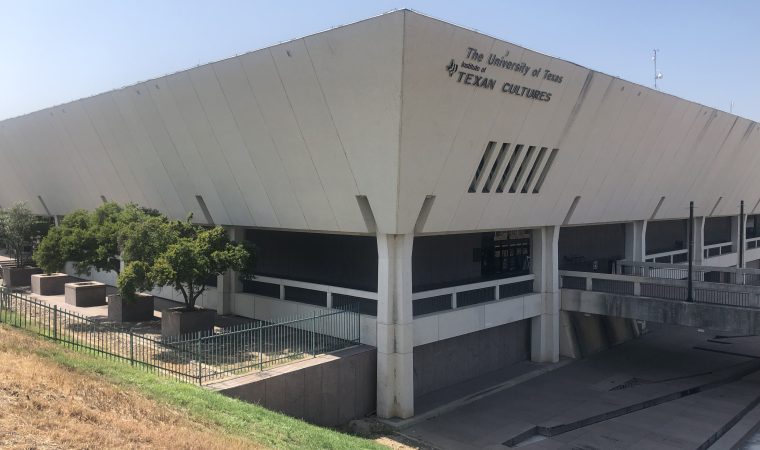
The big news is the recent Texas Historical Commission vote to approve State Antiquities Landmark status for the Texas Pavilion/Institute of Texan Cultures building (Caudill, Rowlett and Scott, 1968). The building is managed by the University of Texas at San Antonio (UTSA) and earlier this year they announced their plan to demolish the Brutalist wonder in summer, 2025. The building was successfully nominated to the National Register of Historic Places earlier this year. The museum has moved out, so the building is eligible for 45% of rehab costs as an investment tax credit.

What now? The big question is the State Antiquities Code, which has special provisions for public institutions of higher education, like UTSA. Although this section of the code has never been implemented or tested, it does allow institutions of higher education to claim an educational need that can outweigh the landmark status. Given that UTSA’s public position is they want to demolish the building and sell the land, it is hard to see them making a relevant argument.

The city also has a secret plan for this area which has been named “Project Marvel”. Yes, really!
Interestingly, the University of Texas system allowed a junior high in Austin to be designated a State Antiquities Landmark, only to have its demolition approved administratively a month later. In that case, it was for a sports facility for the university, which is a better argument than land sale because it actually involves the university occupying the space.

A few things to remember:
- The State doesn’t need a demolition permit to tear down its own property.
- State Antiquities Landmark status – like any landmark status, does not prevent demolition – it only requires a review process. Which technically happened with the Austin building.
- UTSA is an HSI and they are tearing down the only downtown building by a Mexican-American architect. Ouch!
- All of the media coverage discusses the site as a new Spurs stadium. This has been going on for twenty months with precisely NO COMMENT whatsoever by the Spurs. Nada. zilch. zero.

No one is clear what happens next – do we get a hearing on the educational institution exemption? Does the THC get a demolition permit to review? Will UTSA wait until the new year to officially ask for demolition? Is Project Marvel part of the MCU? Stay tuned!!!
NOVEMBER 22 UPDATE!
Yesterday City management updated the City Council about Project Marvel and revealed renderings showing a new Spurs arena where the Texas Pavilion is currently. Project Marvel also includes an expanded Convention Center, a renovated Alamodome, more hotels, and a bridge or tunnel over I-37. Interestingly, the Austin project to bridge I-35 apparently hit a snag (60% cost increase) just a day earlier. Project Marvel also envisions a new 5,000 seat venue in the former Wood Courthouse, returning it to its 1968 role as a theater.

The enthusiastic press coverage quoted the Mayor, most of the City Council, the County Judge and various city officials. The Spurs, consistently, said nothing.
Oh, and the city promised that no taxpayer money would go to a sports stadium. The infrastructure maybe, but not the stadium. That is what they said. Yes, really.
(Well, that lasted a month – now they are gauging how much public money – see latest blog)
Overall the news simply confirms what “the news” has been speculating about for nearly two years. The Conservation Society response? We are still proceeding to defend Texas’ newest State Antiquities Landmark. Hey, it could be part of the plan – given ingenuity and imagination.
We are also not letting the excitement over a $4-$5 billion 15-year dream affect what we do in the next couple of months.
DECEMBER 19 UPDATE:
The Texas Historical Commission has approved a demolition permit for the Texas Pavilion/Institute of Texan Cultures building. The approval has a stack of stipulations before the permit can be issued, so still plenty of time for an injunction. The requirements of owner University of Texas at San Antonio (UTSA) include HABS documentation, interpretation, the potential rehab of another neglected Hemsifair ’68 building and an executed Memorandum of Understanding with the THC. Bad news always arrives during the holidays! Over, not over.
FEBRUARY 2025 UPDATE – Turns out Project Marvel has had some rewrites….
Conserving Heritage in the wake of Historic Preservation.

Way back in 2009 I embraced Donovan Rypkema’s challenge to rebrand “historic preservation” as “heritage conservation,” which I did in a blog here. I had recently finished my dissertation on the history of historic districts, observing how the community planning movement of the late 20th century changed historic preservation from a curatorial pursuit to an exercise in democracy. To be truly democratic, more stories reflecting ALL populations needed to be told, and “heritage conservation” to me included the invaluable efforts to rescue lost history and those sites that have great community significance but little or no architecture.

Or both.
Shortly after that I began an effort which continues to this day to look at ways that the National Register of Historic Places could tell the full American story. The curatorial – and architectural – emphasis of the 1930s-1960s limited these stories. Ned Kaufmann estimated at the turn of the millennium that only 2-4% of National Register sites told the story of women and people of color, and today the number is still likely below 10%. Since 2012 I have participated in or moderated several sessions at the annual PastForward conference of the National Trust for Historic Preservation looking at this issue. 2015 was a highpoint, with a panel discussion at PastForward that included two State Historic Preservation Officers (SHPOs), a presentation at the Advisory Council on Historic Preservation (thanks Brad White!) and a lecture at the Eighth National Forum on Historic Preservation Policy and Practice that was published in 2018 with specific recommendations for amending the National Register and the Secretary of the Interior’s Standards for Rehabilitation. The rubric was Addressing the Diversity Deficit and many people contributed valuable ideas and insights.

My initial presentations on the subject of reforming the National Register and the Secretary’s Standards were met with anger by Carol Shull, longtime Keeper of the National Register, although by 2016 she told me they were “getting better.” I can recall meeting with Julianne Polanco before she was SHPO for California and telling her I wanted to totally redo the National Register. She calmed me down and pointed out that you could do a lot of good for diversity with existing tools if you just used them properly. She was on my 2015 panel at PastForward along with Allyson Brooks, Washington state SHPO. They both used the existing tools very creatively to promote diversity. Consequently, my 2018 recommendations were reforms, not radical recasting. In fact, official National Register guidance began to shift toward heritage conservation that same year when they issued a guidance that said interior spaces that had lost all of their architectural finishes could still retain historic significance under Criterion A (history).

Like this interior of the Forum on 43rd in Chicago. Actually, it has some of its finishes. But is needs to be conserved not because of those finishes but because of the community story they circle.
In 2020 I moderated a PastForward panel that included the new head of the National Register, Sherry Frear and my San Antonio colleague Sarah Zenaida Gould, one of the founders of Latinos in Heritage Conservation (along with Julianne Polanco and many other friends) called “A Deep Dive On Integrity.” This was COVID times, so it was a Zoom panel and it managed to attract over 500 participants. In four weeks I will be on another panel with Sherry and Sarah on the issue of Integrity, at the PastForward conference in New Orleans. In addition to the diversity question, there is also the confusion of “integrity” with structural integrity. The word itself is the problem, dating to 1966 when we Americans were too scared to use the word “authenticity.”

This house has historic integrity, but not structural integrity. The Park Service will be knocking it.
So now there is a dust-up between the Advisory Council on Historic Preservation, led by Sara Bronin, who has issued policy statements and comments on a whole variety of contemporary issues and how preservation should react to them. On the other side are State Historic Preservation Offices and National Park Service folks who actually implement the National Register and the Secretary’s Standards. Most recently, there is a call from ACHP for comment on a series of regulatory streamlining proposals to promote climate resilience.

Pointing to the flood level lines at Mies’ Farnsworth House, c.2009.
Like many of my colleagues in the National Preservation Partners Network, I do not find myself in one camp or another. On the one hand, some of the streamlining proposals from the ACHP comment are canards that either don’t happen (transit line and bike lane planning, review of the inside of residences, mechanical and electrical systems) or have already been accepted as reasonable or reversible (solar panels, engineered wood products). On the other hand, the Secretary of the Interior’s Standards have not been updated or reviewed in over 30 years, which is way too long.

Even in 1990 we did not regulate paint color.
On the one hand, the idea of streamlining regulatory processes is attractive. If it works. If current regulations are turning around in an average three business days, then that is not exactly earth-shattering. The issue does not seem data-driven but anecdote-driven. It feels like a series of solutions in search of a problem. Also, many of the “solutions” were long ago implemented by various agencies who are quite skilled at following the rules.

Not the Postal Service.
On the other hand, I have watched regulators argue about very silly minutiae. Admittedly, I am the opposite of the precious preservationist. I love original materials because they can’t be had today for love or money, but if they are already gone, game over. Bring on the Hardie Board and plastic lumber.

Modern wood is so bad you can see how bad it is at 60 miles an hour.
In addition to not being terribly precious, I am not an architect, so I don’t have tons of faith in technology. One of the articles of faith is that energy upgrades work. I have a lot of experience with energy upgrades whose claims are driven by sales, not data.
One of the suggested policies:
- Broadening the scope of building envelope energy efficiency improvements, including replacement windows, doors, and insulation, without further historic preservation review.
My response:
This fails to take into account three facts. First, many historic windows and doors perform as well as modern replacements. Restored old-growth windows are warrantied for 50-60 more years than contemporary products. Second, window and door ratings are based on the uninstalled product, yet most of the thermal leakage, even in new construction, happens at the frame. Third, while interior insulation could go without review, exterior insulated finish systems (EIFS) can significantly shorten the life of a building’s skin due to the method of installation and quality of materials.

Just do what Barrio Dogg did – ignore the permits and regulations and cover the building with enough goop to change the original proportions!
And then there is the profit motive. Windows and doors may be less than 10% of construction costs but they are among the biggest markups (20-25%) for contractors, so they are a profit center.
At the end of the day it is not about policies or practices, but process. Whether a given state or federal agency is fast or slow in the process is a consideration, but the larger consideration in any democracy is having a public process. If we want to tell the full American story, we need to have a place for everyone to speak.

I have always said that the brilliance of heritage conservation reviews is that unlike zoning, the resource is not graded or commodified: every review is about the individual resource and the conservation of its characteristics as defined and valued by the community. Let’s not lose that.
DECDEMBER UPDATE:
Sara Bronin, Chair of the ACHP, spoke at our Duda Forum on November 16 right after the DRAFT Program Comment on Housing, Climate and Transportation issues was released. I have taken a look at the new document and find that many of the objections I raised in my own comment on the comment were in fact addressed, and I no longer see a tendency to give blanket approval to unproven replacement windows and insulating systems. Much of the document is now focused on glossing over reviews involving repair or maintenance of windows and doors (fine) and maintenance, repair or in-kind replacement of elements like roofing, foundations, canopies and foundations (mostly fine). It encourages caulking, pointing, and weatherstripping and has benefited from some wise input regarding previously painted surfaces and low-pressure water washing. So someone listened!
“A Little Learning…
is a dangerous thing” said Alexander Pope, and he recommended going whole hog (until Alps on Alps arise) or abstaining. Heritage conservation/Historic preservation is a specialized field, and like many specialized fields, the wider world has misapprehensions or misunderstandings about it. We can try to impart a little learning. There are pitfalls though, because misapprehension often rings truer than fact.
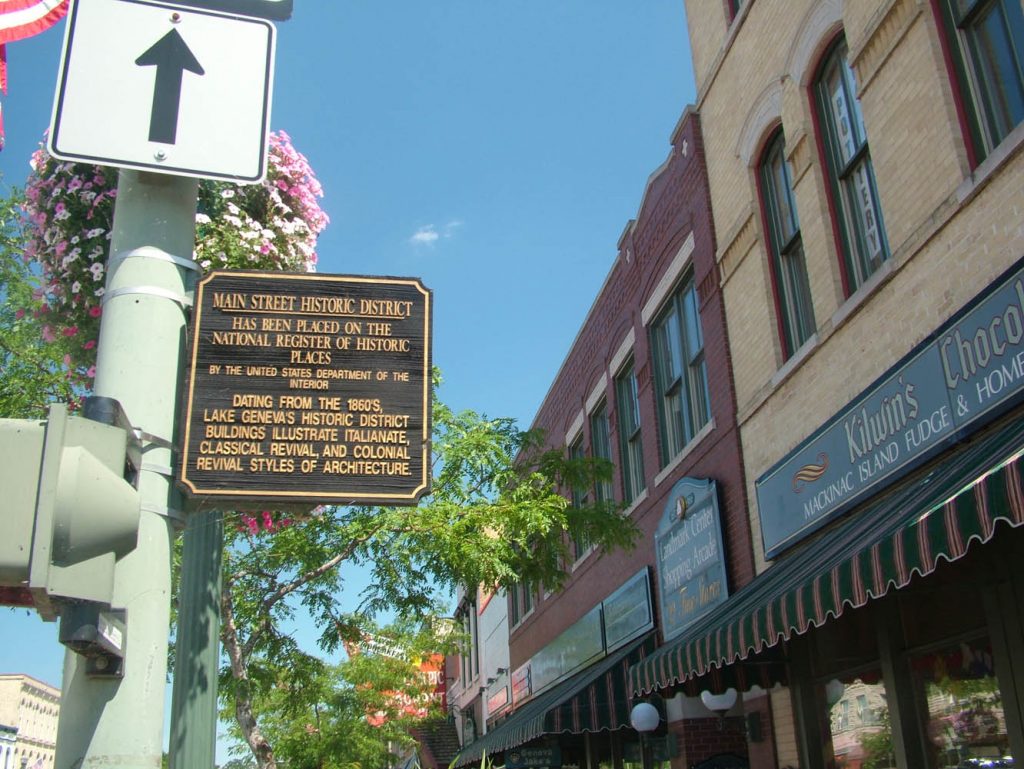
A case in point is the National Register of Historic Places. Its name is often misapprehended as “The National Registry” just because that sounds, well, classier. When a building, site, district or structure is listed on the National Register of Historic Places that means it can’t be torn down, right?
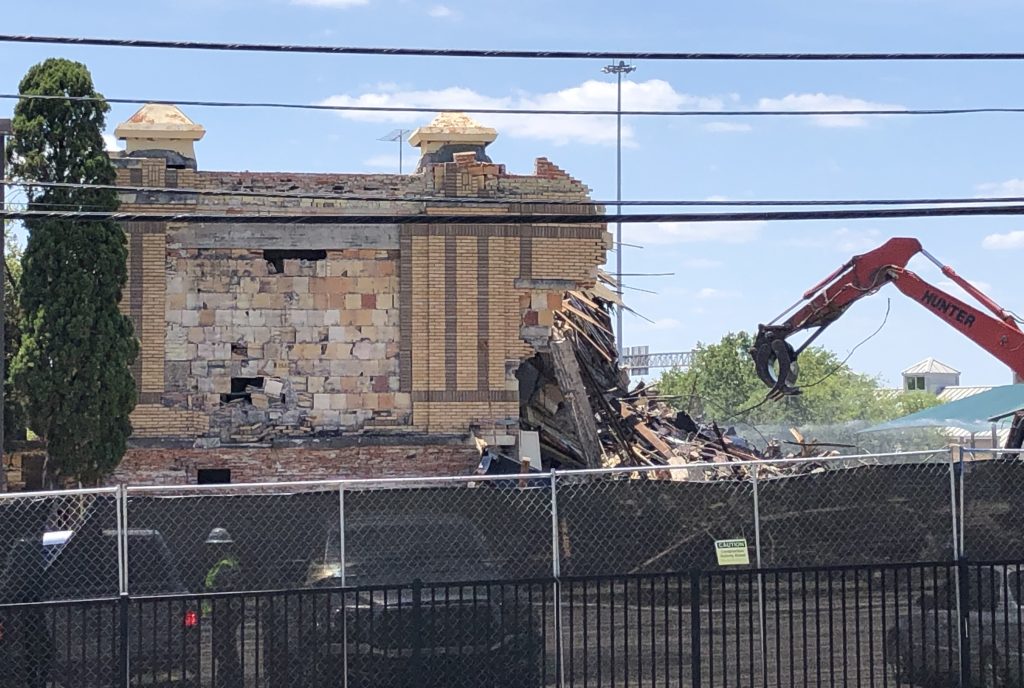
Wrong. Also, Wrong. And Wrong again. The list has been around since 1966 and provides no protection against demolition. It DOES provide a review process that MIGHT make demolition less likely, but that is only if it is literally a federal case. It is kept by the Secretary of the Interior, who will have no idea if anyone is going to tear it down unless a federal agency tells the Secretary they are going to. And they can still tear it down, but only after going through the process.
310 W Polk, Chicago, demolished 1991 by the Postal Service because they knew that the National Register doesn’t prevent demolition.
Now, you can explain that time and time again, but it won’t stick, because the misapprehension is so much more plausible. That’s what it SHOULD mean, right? What really amazes me is that people in high positions dealing with real estate and so forth not only don’t get this, but they suspect there is some weird detail of the National Register that is going to somehow – magically – thwart them. Because it is a specialized field. Fear is always based on lack of knowledge.
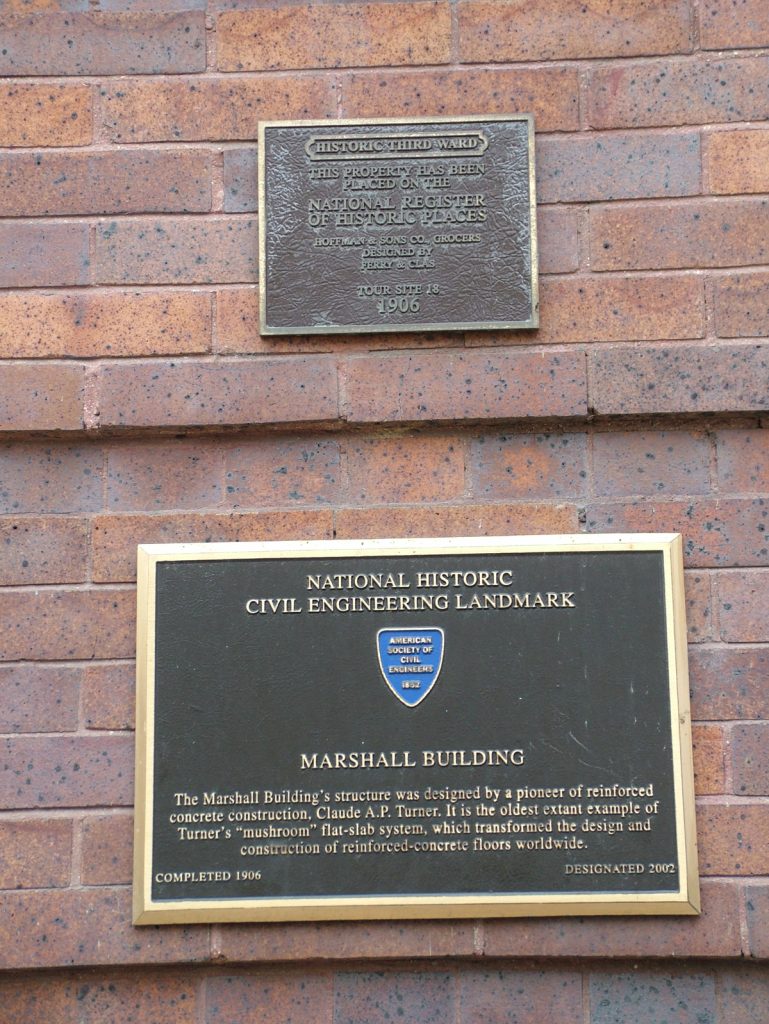
Even though the National Register can’t prevent anyone from tearing down anything (there I said it again, but you still don’t believe it, right?) it can provide – since 1976 – preservation tax incentives that can be used to restore the resource. Part of the reason we have so many buildings on the National Register is that real estate developers put them there in order to get a 20% investment tax credit. $2 million off your taxes for a $10 million rehab. Not bad.

But wait, there’s more! In Texas, you can get an additional 25% tax credit ON TOP of the federal one, so your $10 million rehab only costs you $5.5 million. Or, in the case of the St. Anthony above, more than $24 million in tax credits. So who wouldn’t want the National Register – it can finance your rehab or, you can ignore it and tear it down! No downside, right?

Another historic tax credit project, right across the street.
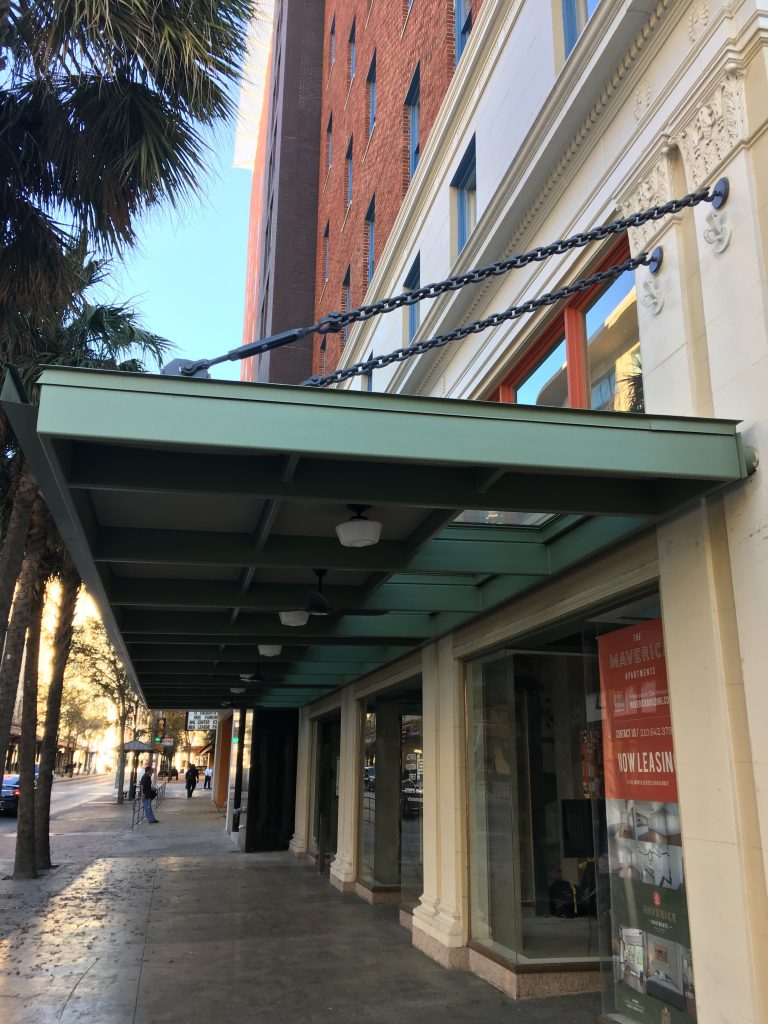
And another, across the street again. Not rocket science.
No downside unless you are a victim of misapprehension, or magical thinking. Case in point: the Conservation Society of San Antonio has nominated of the Texas Pavilion/Institute of Texan Cultures building (1968, Caudill, Rowlett & Scott) to the National Register of Historic Places. Its owner, the University of Texas at San Antonio, is going to oppose the nomination because they want to “monetize the site.”

Okay. Site. Money. Weren’t we just talking about a tax incentives worth 45% of rehab cost? That would be an attraction to someone buying it. BUT, they assume it will be torn down so Spurs Stadium IV (A New Hope) can be built on a smaller site than the Spurs II and III. So? You are the UT System, you can do what you want. In fact, the State and the UT system don’t even have to ask the city for a demolition permit like the rest of us.

As they proved with the Sutton Building in 2019.
So why would you oppose National Register listing if it adds potential incentives and doesn’t prevent demolition? How could you be so powerful and not understand your power? You don’t quite believe that truth because it doesn’t feel true – this is the National Registry (sic) after all!
Civilization and the current moment are saturated with people following courses of action that contradict their fiduciary responsibilities because they have a better storyline. This National Register thing has got to be a big green dragon – it can’t be as innocuous as they say, right?

Oh look, another historic tax credit project!
A good storyline beats the bottom line any day.
A little learning is a dangerous thing.
JANUARY UPDATE: We got a unanimous vote from the State Review Board so now it is up to the State Historic Preservation Office to forward the nomination to the Keeper of the National Register (or not). We had 9 speakers in favor at the hearing in Galveston and they also received 47 letters of support and many more online expressions of support. UTSA provided the sole opposition to the listing.
FEBRUARY UPDATE: University of Texas Board of Regents voted in secret to either lease or sell the ITC to the City for a new Spurs arena. No one is talking, though.
The Spurs probably have enough tax liability that they could use the historic preservation tax credits themselves, avoiding a syndication!
Diversity and American History

I took this picture in the United States.
For several years I have been working on a problem: the “Diversity Deficit” in the National Register of Historic Places. 95% or more of our historic sites have as their primary significance the story of a male of European descent. You can see some of this year’s blogs on the topic here and here. Continue Reading
National Historic Preservation Act: Addressing the Diversity Deficit

Two weeks ago I spoke during the meeting of the Advisory Council on Historic Preservation regarding the Future of the National Register of Historic Places, which will be 50 years old next year. I detailed some of the shortcomings that have emerged over that time, including a startling “Diversity Deficit.”
Less than 5% of the buildings listed on the National Register evoke the nation’s diverse history – the rest chronicle white men, who are much less than half the country. I also detailed many of the challenges in preservation practice that we inherited from an architect-driven 1960s practice, one that has a tendency to focus too much on the formal.
The photo is one of may favorite examples, from St. Nicholas Avenue in Hamilton Heights, New York, the building lacks architectural integrity. But Ralph Ellison wrote Invisible Man there in 1947, a book more relevant than ever today. The building is authentic but does not have integrity. The problem is not the building but our practice – we adopted the architectural concept of “integrity” in 1966 instead of the international concept of “authenticity.” Continue Reading
Conserving Buildings and Preservation Laws

Almost a year ago in Austin, new National Trust President Stephanie Meeks outlined her plan for the Trust going forward, which I reviewed here. In that speech, she said preservationists need to become more visible beyond those who just say “No!” Continue Reading