Conservation Society sues to halt demolition of Texas Pavilion but it goes on

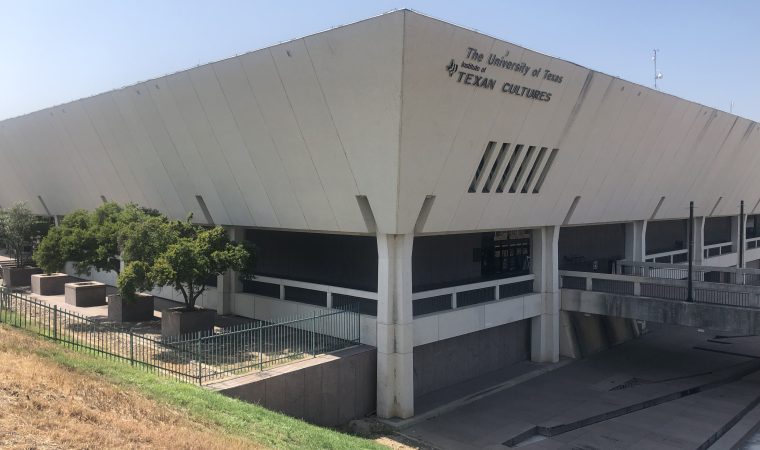
April 26, 2025 the Conservation Society of San Antonio filed a lawsuit to halt demolition of the 1968 Texas Pavilion in downtown San Antonio. The only downtown building by a Mexican-American architect, the pavilion was home of the Institute of Texan Cultures and Texas Folklife Festival for over 50 years. Owned since 1973 by the University of Texas at San Antonio, the building was listed on the National Register of Historic Places AND as a State Antiquities Landmark last year. And it is being demolished.

LEARNING MOMENTS:
- Yes, you can tear down buildings on the National Register of Historic Places. How could a federal designation get in the way of a local building permit?
- The National Historic Preservation Act gets triggered if there is a federal undertaking (which includes funding) to demolish a National Register property, which the City claims there isn’t. Except their public statements say there is, so … lawsuit.
- State Antiquities Landmark designation CAN stop a demolition by the State, unless the Texas Historical Commission approves it, which they did. Without a hearing. Not even by the Texas Historical Commission. So …. lawsuit.

We have spent the last two and a half years trying to get these two designations for this building, ergo you can read about the background here, here, and here. As with most preservation cases, the odds are stacked against us, a mere David standing across from the goliaths of UTSA and the City, who have recently joined with the County to discuss the implementation of Project Marvel, which envisions an expanded Convention Center, new hotel, Spurs (NBA) stadium, revamped Alamodome, revitalized Confluence Theater, and a land bridge over I-37. I covered Project Marvel and all one of its illustrations here in December.

We have received a lot of supportive comments and President Lewis Vetter has been interviewed in many media. As we have said for years, we support the downtown Spurs stadium and Project Marvel. BECAUSE the Texas Pavilion is a Marvel-ous building to use as part of the project! Check out our website for updates and membership information here!

AND, A WEEK LATER it seems they may be accelerating the demolition. They have ripped down (not removed, done with a backhoe) several of the iconic concrete panels from the building. We went to court to get a TRO and UTSA is claiming that they are only doing remediation and removed the panels to access things they had to remediate. Ummm, that doesn’t jive with the visuals:

APRIL 16 UPDATE
On Monday, April 14 UTSA and the City had ten lawyers in the courtroom as they successfuly convinced Judge Tina Torres that both entities had “sovereign immunity” and that the court had no jurisdiction to even HEAR the suit. The Conservation Society filed a notice of appeal to the 15th Court of Appeals on Wednesday. Meanwhile, destructive demolition has continued without pause.
MAY 16 UPDATE
The 15th Court of Appeals denied our motions for an emergency relief and an injunction. With a heavy heart and recognizing the effects of three months of demolition, the Conservation Society decides to end its pursuit of a hearing on the merits of the case. Goliath won.
How to demolish a MCM landmark, clumsily.

The surprising thing about the impending demolition (they have started on remediation, the most expensive part UNLESS you are keeping the building) of the Texas Pavilion/Institute of Texan Cultures Building is not that the Texas Historical Commission issued a demolition permit without public comment less than two months after listing the building as a State Antiquities Landmark. That was certainly NOT surprising since they had just done the same thing with University Junior High in Austin – landmark it and then six weeks later allow it to be demolished.

It is also not surprising that the demolition permit came just a month after the City finally revealed Project Marvel, a singular rendering centered on a potential Spurs stadium. The Spurs have the superstar of the decade and their current venue is more than 20 years old, which is what, 100 in professional sports years? What IS surprising is the recent revelation that Project Marvel started – and could easily finish – without a Spurs stadium. Or a UTSA hotel program. Turns out those were late additions to the project, according to City Council members at a public meeting this week. And the project could go without them.

That explains why there is only one rendering. The hotel even looks like a late cut-and-paste.
UTSA’s rush to demolish seems a little odd, as does their deal last year to sell, lease or “give” the building to the City. Yes, the city wants it back after giving it to the state in 1967 for a permanent museum. But UTSA kept saying they wanted to “monetize” the site – why would they “give” it to the city? Especially after a really expensive remediation and demolition?

That is 1963 US Gypsum building in Chicago when it was about 10. It was demolished three decades ago, costing $4 million, of which $3 million was for remediation.
Well, one reason is that UTSA as a state agency doesn’t have to bother with demolition permits from the city. If the city owned it, there would be a public hearing, and one thing UTSA has avoided assiduously for the last eight years is any public hearing. I remember going to the public meetings about their master planning six years ago – which included every parcel they owned EXCEPT the Texas Pavilion/ITC.

Since the new President of UTSA arrived, they have wanted to get rid of the building. They pulled back a Request for Proposals that had been issued in 2016 for developers interested in the site. Odd, because “monetization”? Then COVID came to the rescue and within months they cut staff by 80%. The Texas Folklife Festival, which had been the lifeline for the ITC, ended, and soon other events were moved to other locations. They convened task forces and the ULI to study the building so that everyone knew it needed $80 million – except the 2023 engineering report on their website that said $7 million. And last Memorial Day they closed it and moved the collections out. So now it is just a Brutalist hunk.

This is how you demolish a Mid Century Modern landmark. I call it the POLYESTER PANTS method because I first saw it at work in 1980s Chicago with a lovely 1930 building called Hillman’s. Hillman’s had a ground floor “grocery” called Stop and Shop that was the classiest thing in town – the ultimate upscale bodega, a unique experience and a beloved place. If they had announced they were demolishing Stop and Shop there would be an uproar.
So they got rid of that use and put in a place that sold two pairs of polyester pants for $12. Within a year or too, the polyester pants have successfully distanced the building from its fan base and Boom! down it goes.

So, no more Folklife Festival, no more staff, just those pesky Conservation Society folks loading up the old Institute of Texan Cultures building with landmark titles. Sadly, as I explained late last year, those titles only provide a review – nothing guarantees preservation. And when you have one state entity regulating another, well, you can see that there is no independent arbiter here.
Aw heck, transparency and oversight are out of fashion anyway, right? Want some polyester pants?
“A Little Learning…
is a dangerous thing” said Alexander Pope, and he recommended going whole hog (until Alps on Alps arise) or abstaining. Heritage conservation/Historic preservation is a specialized field, and like many specialized fields, the wider world has misapprehensions or misunderstandings about it. We can try to impart a little learning. There are pitfalls though, because misapprehension often rings truer than fact.
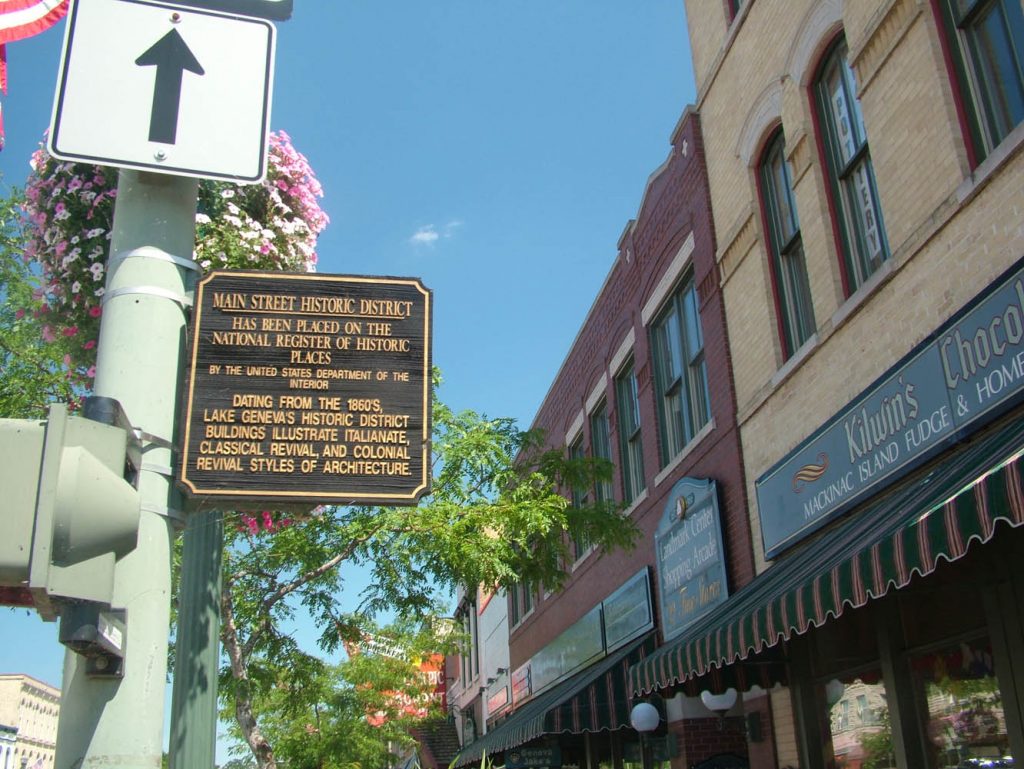
A case in point is the National Register of Historic Places. Its name is often misapprehended as “The National Registry” just because that sounds, well, classier. When a building, site, district or structure is listed on the National Register of Historic Places that means it can’t be torn down, right?
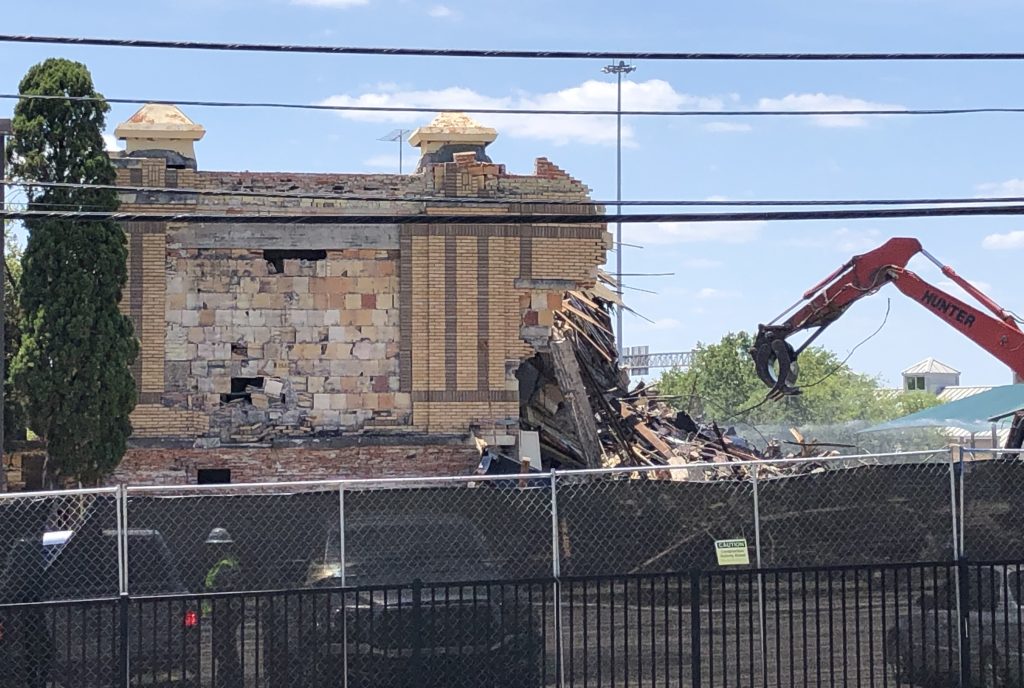
Wrong. Also, Wrong. And Wrong again. The list has been around since 1966 and provides no protection against demolition. It DOES provide a review process that MIGHT make demolition less likely, but that is only if it is literally a federal case. It is kept by the Secretary of the Interior, who will have no idea if anyone is going to tear it down unless a federal agency tells the Secretary they are going to. And they can still tear it down, but only after going through the process.

310 W Polk, Chicago, demolished 1991 by the Postal Service because they knew that the National Register doesn’t prevent demolition.
Now, you can explain that time and time again, but it won’t stick, because the misapprehension is so much more plausible. That’s what it SHOULD mean, right? What really amazes me is that people in high positions dealing with real estate and so forth not only don’t get this, but they suspect there is some weird detail of the National Register that is going to somehow – magically – thwart them. Because it is a specialized field. Fear is always based on lack of knowledge.
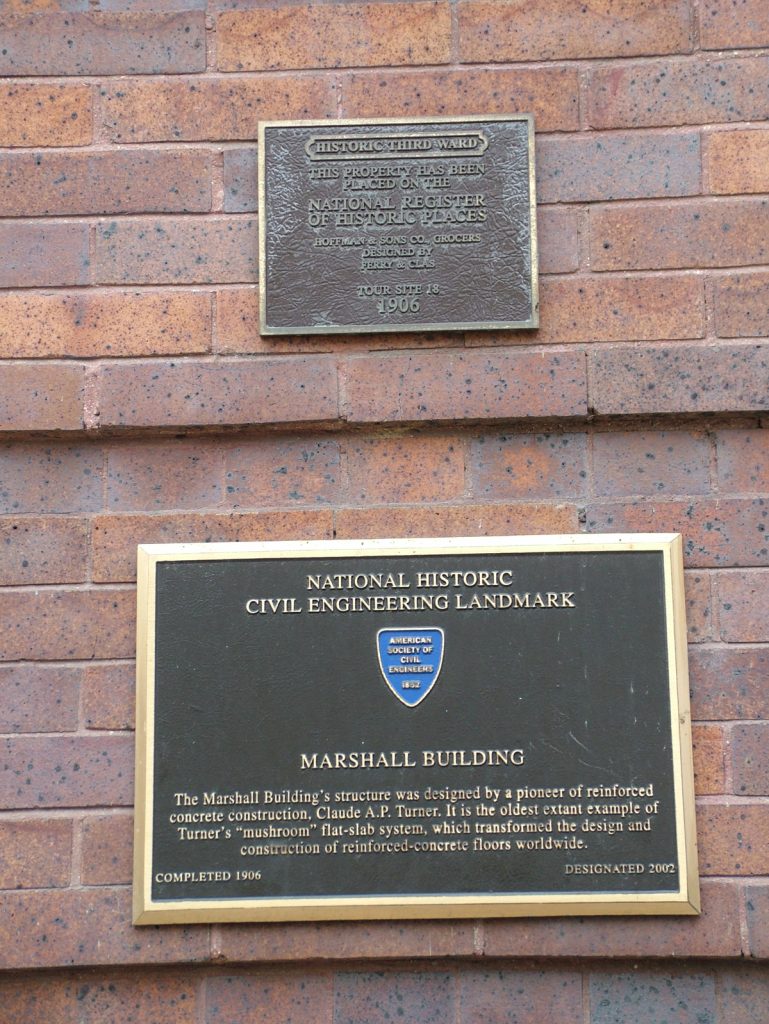
Even though the National Register can’t prevent anyone from tearing down anything (there I said it again, but you still don’t believe it, right?) it can provide – since 1976 – preservation tax incentives that can be used to restore the resource. Part of the reason we have so many buildings on the National Register is that real estate developers put them there in order to get a 20% investment tax credit. $2 million off your taxes for a $10 million rehab. Not bad.

But wait, there’s more! In Texas, you can get an additional 25% tax credit ON TOP of the federal one, so your $10 million rehab only costs you $5.5 million. Or, in the case of the St. Anthony above, more than $24 million in tax credits. So who wouldn’t want the National Register – it can finance your rehab or, you can ignore it and tear it down! No downside, right?

Another historic tax credit project, right across the street.
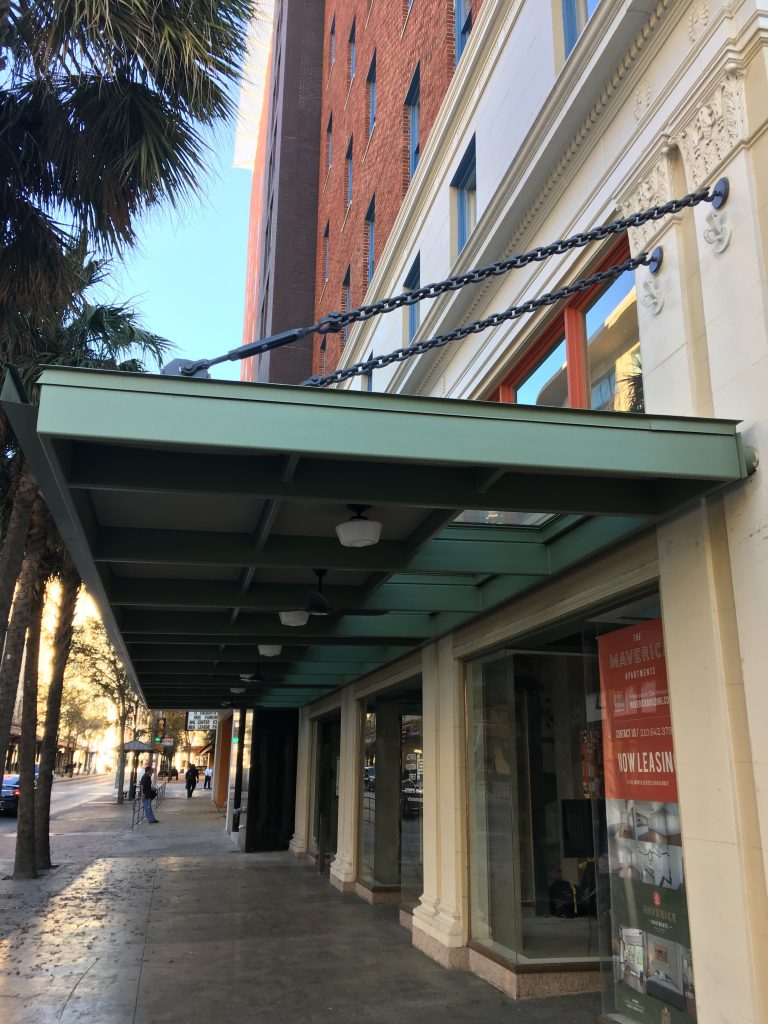
And another, across the street again. Not rocket science.
No downside unless you are a victim of misapprehension, or magical thinking. Case in point: the Conservation Society of San Antonio has nominated of the Texas Pavilion/Institute of Texan Cultures building (1968, Caudill, Rowlett & Scott) to the National Register of Historic Places. Its owner, the University of Texas at San Antonio, is going to oppose the nomination because they want to “monetize the site.”
Okay. Site. Money. Weren’t we just talking about a tax incentives worth 45% of rehab cost? That would be an attraction to someone buying it. BUT, they assume it will be torn down so Spurs Stadium IV (A New Hope) can be built on a smaller site than the Spurs II and III. So? You are the UT System, you can do what you want. In fact, the State and the UT system don’t even have to ask the city for a demolition permit like the rest of us.

As they proved with the Sutton Building in 2019.
So why would you oppose National Register listing if it adds potential incentives and doesn’t prevent demolition? How could you be so powerful and not understand your power? You don’t quite believe that truth because it doesn’t feel true – this is the National Registry (sic) after all!
Civilization and the current moment are saturated with people following courses of action that contradict their fiduciary responsibilities because they have a better storyline. This National Register thing has got to be a big green dragon – it can’t be as innocuous as they say, right?

Oh look, another historic tax credit project!
A good storyline beats the bottom line any day.
A little learning is a dangerous thing.
JANUARY UPDATE: We got a unanimous vote from the State Review Board so now it is up to the State Historic Preservation Office to forward the nomination to the Keeper of the National Register (or not). We had 9 speakers in favor at the hearing in Galveston and they also received 47 letters of support and many more online expressions of support. UTSA provided the sole opposition to the listing.
FEBRUARY UPDATE: University of Texas Board of Regents voted in secret to either lease or sell the ITC to the City for a new Spurs arena. No one is talking, though.
The Spurs probably have enough tax liability that they could use the historic preservation tax credits themselves, avoiding a syndication!
A New LEED for Preservation?

Shedd Park fieldhouse, William Drummond
Four years ago the National Trust for Historic Preservation jumped firmly into the sustainability fray with then-President Dick Moe’s speech at the National Building Museum. (Here is my blog from that time.)
The Trust will continue its leadership in this arena next month under Stephanie Meeks when it reveals the Life Cycle Analysis of historic buildings undertaken by the Preservation Green Lab in Seattle. This provides a perfect complement to the Life Cycle Analysis of new buildings recently undertaken by the American Institute of Architects, and one of my own initiatives of late is to try to bring the AIA and National Trust together on these complementary initiatives.
Life cycle analysis takes us into REAL sustainability because it asks the straightforward question: how long does an investment in a building last? My classic replacement window conundrum is a good example. If a restored wood window costs 3 times as much as a cheap plastic replacement window but last 5 times as long, it is cheaper over the life cycle of the building.
Continue Reading
Marfa, Texas

Marfa, Texas is a town with one stop light named after a character in a Dostoevsky novel and a far drive from just about everywhere else in the world. But its isolation hasn’t prevented it from becoming a destination and famous place for longer than I have been on earth. You can begin with the lovely Second Empire Presidio County Courthouse in the center of town, preserved as part of the great courthouse preservation program of the Texas Historical Commission.
The courthouse square seems unfinished, with most of the buildings on one end of it, closer to the intersection two blocks away with the road that matters, the one that connects to Alpine, at 5700 people nearly thrice as large, and El Paso, 3 hours distant. Marfa has some great buildings from the early 20th century, most notably the Hotel Paisano, with plaques aplenty describing its architectural landmark status and shops dedicated to the Marfa’s first great film, James Dean, Rock Hudson and Elizabeth Burton’s GIANT (Dennis Hopper also appeared). Continue Reading